Stranded Copper Wire 4 Core Cable RVV 4x6.0mm² PVC Flexible 300/500V
Cable Designation & Meaning
|
Code
|
Meaning
|
|
RVV
|
R = Flexible copper conductor (Class 5), V = PVC insulation, V = PVC sheath
|
|
300/500 V
|
Rated voltage U₀/U = 300/500 V; Uₘ = 500 V
|
|
4×6.0 mm²
|
Four flexible cores, each 6.0 mm² copper conductor (custom size)
|
Construction: Extra-heavy PVC sheathed flexible cord, round profile (4-core)


RVV 4×6.0 mm² — Cable Specification & Engineering Data
1. Product Overview & Rating Summary. RVV 4×6.0 is a four-core flexible PVC-insulated PVC-sheathed cord rated at 300/500 V AC (50 Hz) and 70 °C conductor temperature, built around four 6.0 mm² annealed copper Class 5 flexible conductors — each PVC-insulated and collectively jacketed in a second PVC oversheath. Manufactured and type-tested to GB/T 5023.5 (60227 IEC 53) / IEC 60227-5, with flexible conductors per GB/T 3956. Finished diameter is about 14.8 mm and nominal mass about 470 kg/km (≈ 47 kg per 100 m), supplied on 100 m reels or cartons. With all four cores energised, the cord carries about 41 A in free air at 25 °C (engineering estimate) — the largest common 300/500 V four-core flexible cord, intended for cooker circuits, immersion heaters and small three-phase loads where flexibility is essential.
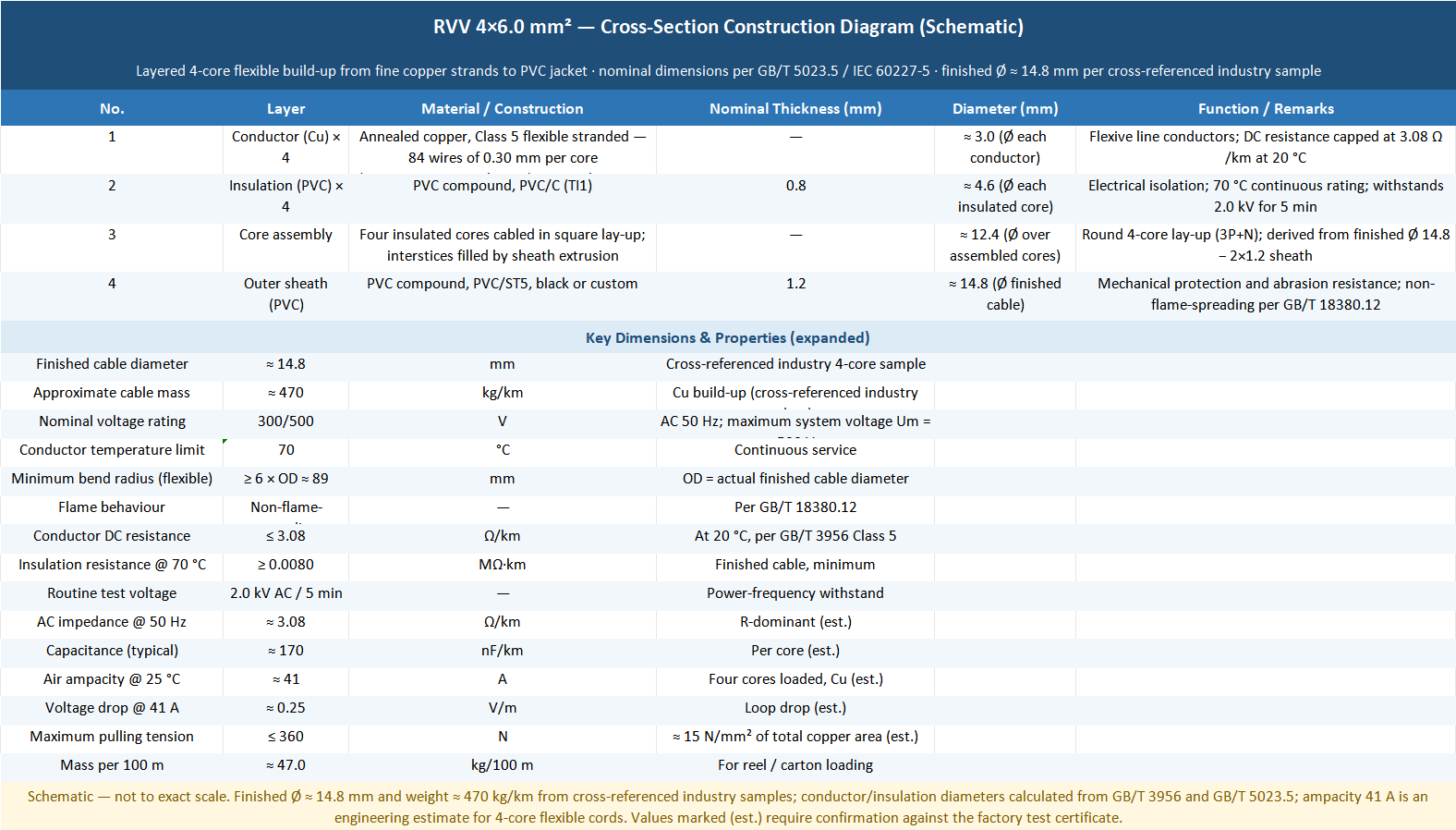
2. Layer-by-Layer Construction (Conductor to Jacket).
| Layer |
Construction |
Wall |
Diameter |
| Conductor (Cu) × 4 |
Annealed Cu, Class 5 flexible stranded, 84 × 0.30 mm (1+6+12+18+24+23) each |
— |
≈ 3.0 mm |
| Insulation (PVC) × 4 |
PVC compound, PVC/C (TI1) |
0.80 mm |
≈ 4.6 mm |
| Core assembly |
Four insulated cores cabled in square lay-up; interstices filled by sheath extrusion |
— |
≈ 12.4 mm (derived) |
| Outer sheath (PVC) |
PVC compound, PVC/ST5, black or custom |
1.20 mm |
≈ 14.8 mm (finished) |
3. Electrical Characteristics. Each 6.0 mm² conductor is held to a maximum DC resistance of 3.08 Ω/km at 20 °C, rising to around 3.91 Ω/km at the 70 °C operating point. Every length survives the routine 2.0 kV AC power-frequency proof held for five minutes. Finished-cable insulation resistance remains above 0.0080 MΩ·km at 70 °C, and typical figures include capacitance ≈ 170 nF/km and 50 Hz AC impedance ≈ 3.08 Ω/km (resistance-dominant). With all four cores energised, reference loading is about 41 A in free air at 25 °C (engineering estimate), and the loop voltage drop at 41 A is about 0.25 V per metre.
Electrical Parameters
Reference values: 6 mm² flexible cord — typical current carrying capacity 28–40 A. For 3-phase + PE at 400 V, max balanced load ≈ 23.6 kW (34 A per phase). At 34 A, voltage drop ≈ 4.0 V/km per core (≈1.0% per 100 m at 400 V line-to-line).
Temperature Characteristics
- Max. conductor operating temp.: 70 °C
- Max. short-circuit temp. (≤5 s): 160 °C
- Emergency overload temp.: 85 °C
- Min. installation ambient temp.: −15 °C (PVC flexible)
- Service ambient range: −15 °C to +70 °C (PVC sheath)
Fire Performance (RVV 6 mm² custom)
|
Property
|
Value / Requirement
|
|
Flame retardant
|
Single flame test (GB/T 18380.12)
|
|
Halogen content
|
Contains Cl (PVC), produces HCl
|
|
Smoke density
|
Heavy dark smoke
|
|
Corrosivity
|
Corrosive HCl gas
|
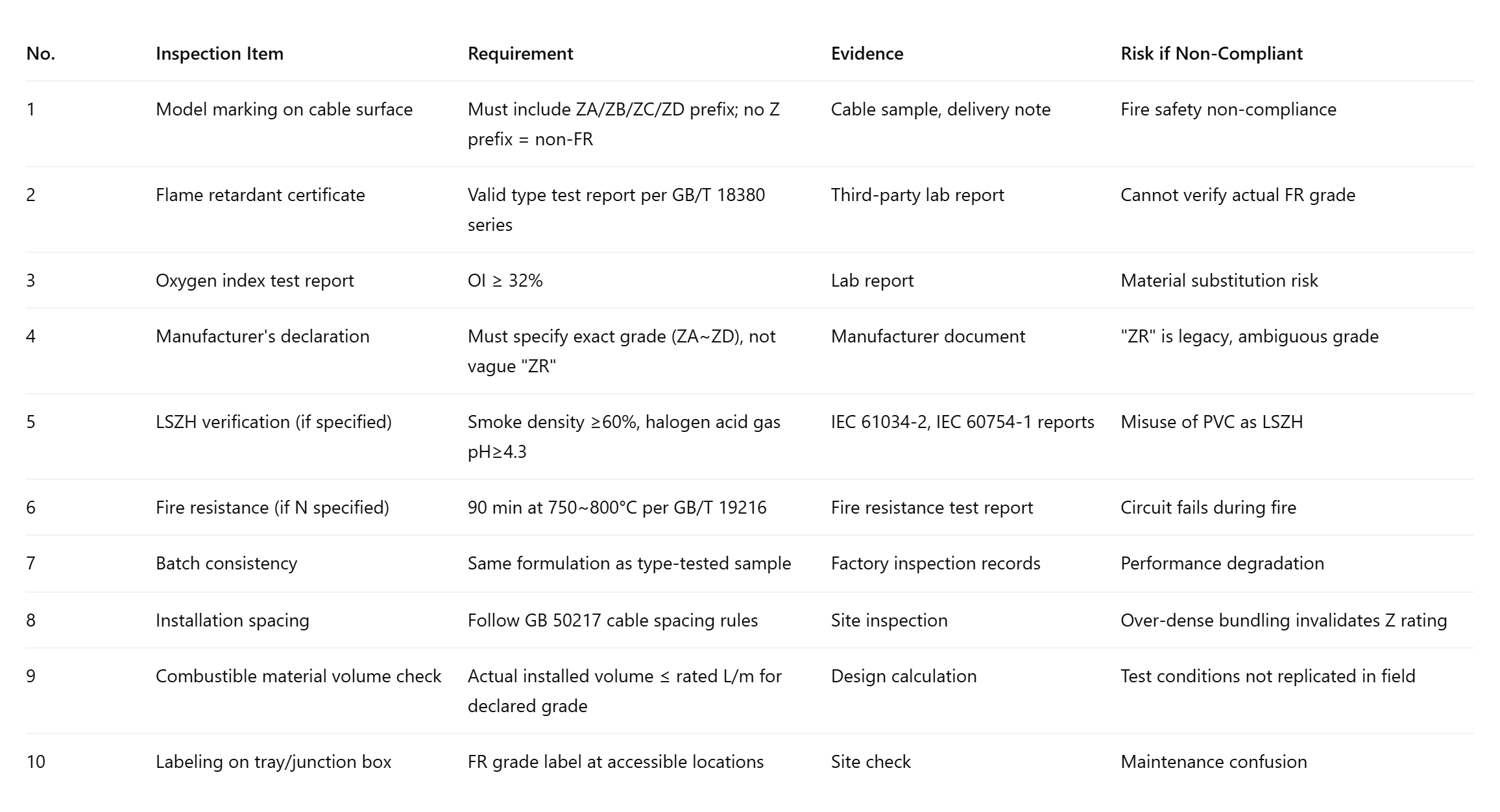
4. Thermal Response & Flame Behaviour. PVC insulation sustains a 70 °C continuous conductor temperature. The cord is rated for service ambients between −15 and +70 °C, must not be uncoiled below 0 °C without pre-conditioning, and uses 25 °C as the reference ambient for ampacity. Flame behaviour meets the single-cable vertical test GB/T 18380.12 (IEC 60332-1), meaning the cord self-extinguishes when the flame source is removed. Because both insulation and sheath are halogenated PVC, the cord emits smoke and hydrogen chloride in a fire; low-smoke zero-halogen projects must specify an LSZH variant.
5. Installation Practice & Handling. Bends must not fall below 6 times the actual outer diameter — about 89 mm for this size. Termination requires stripping 20–22 mm and always using a ferrule on the flexible Class 5 strands to prevent wire fraying. Reels held below 0 °C in storage must be warmed indoors before uncoiling; pulling tension should stay within 360 N, and the cord must never be used as a pulling rope. The 41 A reference requires derating whenever ambient temperature or bundling deviates from reference conditions. This cord is not for direct burial, outdoor UV exposure or continuous repetitive flexing — for those duties choose an armoured cable, a UV-stabilised jacket or a continuous-flex (trunking) cable respectively.
Mechanical & Installation Parameters
- Minimum bending radius: ≥ 6 × OD → ≈ 85 mm at Ø14.2 mm
- Max. pulling tension: light, avoid pulling; use strain relief gland
- Direct burial: NOT suitable
- Conduit ID: ≥ 1.5 × OD → ≥ 21 mm; use 25 mm or 32 mm conduit
- Fixing: cable clips, cable ties
- Flexing: suitable for light flexing only
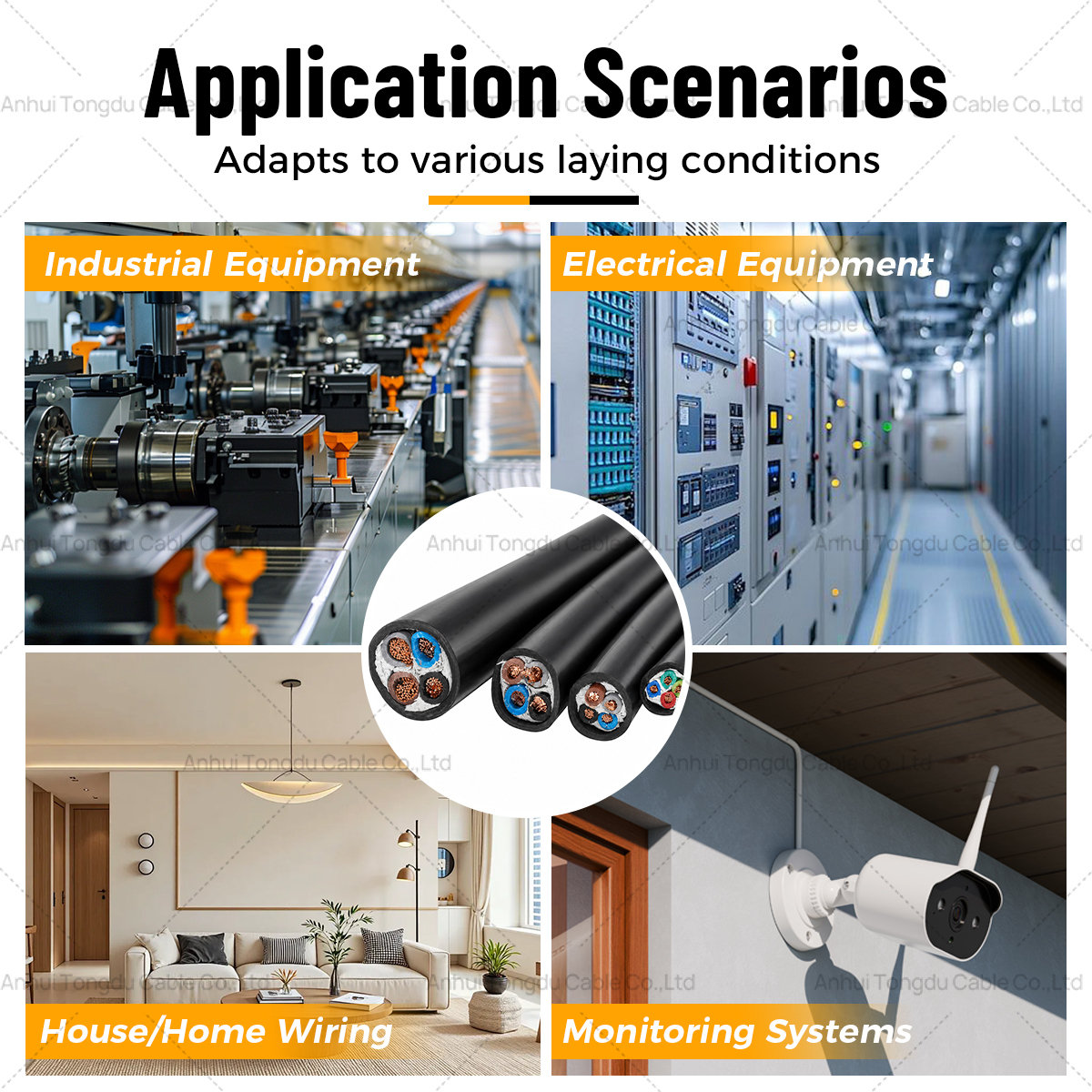
6. Typical Service Applications. This four-core cord is the heavy-duty flexible link for 41 A-class loads: domestic cooker and oven circuits up to about 8 kW, immersion heater and electric shower supplies, three-phase supply to small compressors and refrigeration racks up to about 2.2 kW, industrial welding-machine and battery-charger leads, interconnection between distribution boards and sub-boards, air-conditioner and heat-pump outdoor-unit feeds, pump and fan motor leads, workshop machinery and bench-tool power drops, laboratory equipment and test-set supplies, stage and exhibition temporary power distribution, agricultural greenhouse and irrigation controls, and EV-charger / car-wash equipment interconnects. Approved installation methods include fixed wiring inside appliances, cable trunking and indoor ducting in dry locations, both indoors and in covered sheltered spaces.
7. Testing & Quality Assurance Regime. Routine tests on every length include conductor DC resistance verification (≤ 3.08 Ω/km at 20 °C), the 2.0 kV AC / 5 min withstand, conductor continuity across all four cores, and dimensional inspection covering insulation ≥ 0.80 mm, sheath ≥ 1.20 mm and overall diameter ≈ 14.8 mm. Sample and type tests comprise PVC insulation and sheath tensile strength (≥ 10 MPa) with elongation (≥ 100 % insulation / ≥ 125 % sheath), PVC heat deformation at 80 °C, PVC shrinkage at 150 °C, the single-cable vertical flame test, bending and cold-bend tests at −15 °C, and the voltage test after flexing. A factory test certificate accompanies each reel.
Cable Parameters


Cable Cross Section Structure

Cable Construction Description

8. Standards & Conformity. Design and production are governed by GB/T 5023.5 and IEC 60227-5 for 300/500 V flexible cords (60227 IEC 53). Conductors satisfy GB/T 3956 / IEC 60228 Class 5 — the 6.0 mm² conductor as eighty-four wires of 0.30 mm with R ≤ 3.08 Ω/km. Flame behaviour is proven by GB/T 18380.12. General test methods follow GB 5023.1 / GB 5023.3, while surface marking complies with GB/T 6995. Cables can also be supplied to IEC, BS, DIN, UL or VDE requirements on request. Because the PVC jacket contains halogen, tunnels, metro systems, hospitals and other confined public areas call for an LSZH variant.

9. Packaging, Storage & Logistics. Standard delivery is 100 m per reel or carton, with bespoke cut lengths available on request. Each reel carries type, voltage, supplier identity, production year and sequential metre marking per GB/T 6995. Storage should be in dry, covered premises at −15 to +40 °C, shielded from direct sunlight, moisture, oils and sharp objects; reels remain sealed until installation. In cold conditions, condition reels indoors to ≥ 0 °C before uncoiling. During transit, reels must be secured against rolling and impact, and the cord must never be dragged across abrasive ground or sharp edges.

10. Procurement Specification. State "RVV 300/500 V 4×6.0" together with the required length or reel arrangement, insulation colour combination and marking preferences. Specify the sheath colour (black is standard) and any special colour-coding (e.g. black/red/blue/yellow-green for three-phase plus earth, or four distinct colours for control circuits). Always request the factory test certificate to confirm the actual diameter (≈ 14.8 mm), weight (≈ 470 kg/km) and conductor resistance for the production batch. Where low-smoke zero-halogen or continuous-flex construction is needed, order the LSZH or H05VV5-F variant respectively.
11. Cable Industry FAQ.
- Q1: Why step up from 4×4.0 (32 A) to 4×6.0 (41 A)? The larger cross-section raises ampacity from about 32 A to 41 A and cuts resistance from 4.95 to 3.08 Ω/km — enough for cooker circuits, immersion heaters and small three-phase motors up to about 2.2 kW that would overheat a 4.0 mm² cord. Stay with 4.0 mm² for loads up to 32 A; 6.0 mm² is the next size for cooker and heater circuits.
- Q2: What does Class 5 flexible conductor mean? Class 5 (GB/T 3956) is made of many thin wires (84 × 0.30 mm at 6.0 mm²), giving the cord its flexibility and bend endurance. Class 2 (used in power cables like YJV) uses fewer thicker wires and is much stiffer — never mix them up when ordering.
- Q3: Can a 4×6.0 cord drive a cooker or immersion heater directly? Yes — this is the standard application. A 6.0 mm² four-core cord supports up to about 41 A, enough for a typical 6–8 kW cooker or a 3 kW immersion heater. Always coordinate the cord with the upstream 32 A or 40 A circuit breaker.
- Q4: Why is 6.0 mm² rated at about 41 A while power cables carry far more? Cross-section directly determines current-carrying capacity. 6.0 mm² is still a light-duty flexible cord cross-section; 10.0 mm² already carries about 57 A and 16.0 mm² about 76 A. Oversizing unnecessarily increases cost, diameter and copper weight.
- Q5: Can RVV be used outdoors? Not in its standard form: the PVC jacket is not UV-stabilised and will degrade under prolonged sunlight. For outdoor use specify a UV-stabilised jacket or an armoured cable. For burial, use a steel-tape armoured power cable.
- Q6: How is the conductor cross-section chosen for a cooker or heater circuit? Selection follows (a) full-load current after derating, (b) permissible voltage drop (typically ≤ 5 % for appliance leads), and (c) coordination with the upstream fuse or circuit breaker. A 6.0 mm² cord supports up to about 41 A; cooker circuits above 41 A require 10.0 mm².
- Q7: Copper or tinned copper conductor? Bare annealed copper (this RVV) is standard for fixed appliance leads and gives the lowest resistance. Tinned copper is preferred where the conductor may be exposed to moisture or where solder termination is used, because it resists oxidation.
- Q8: Why can PVC only run at 70 °C while XLPE runs at 90 °C? PVC is a thermoplastic that softens and deforms at elevated temperature; XLPE is cross-linked into a thermoset network that retains its shape up to 90 °C. This is why RVV (PVC) is limited to 70 °C and YJV (XLPE) to 90 °C.
- Q9: Why does finished diameter vary between manufacturers for the same nominal size? Standards set minimum insulation and sheath thicknesses plus electrical performance, but not a precise overall diameter. Stranding compaction, filler design and sheath tolerance differ between plants — published 4×6.0 figures cluster around 14.8 mm — so the actual measured diameter must be used when sizing glands and clips.
- Q10: Which tests confirm acceptability on delivery and before energisation? At delivery, verify the factory test certificate (resistance ≤ 3.08 Ω/km, 2.0 kV/5 min withstand, dimensions ≈ 14.8 mm), jacket legibility and reel integrity. After installation, complete an insulation-resistance test plus a 2.0 kV AC / 5 min withstand, then confirm all four conductors identified correctly before energising.
- Q11: What service life can be expected? When installed and operated within the stated temperature and voltage limits, PVC flexible cords are designed for a service life of around 10–15 years in dry indoor conditions; sustained overload, repeated flexing beyond the 6 × OD minimum radius, ultraviolet exposure, or operation above 70 °C will materially shorten that life.
Product Tags:

|
|
Stranded Copper 2 Core Flexible Cable Wire RVV 4x6.0mm2 PVC Flexible 300V 500V Images
|

